Help that is easy to ask for.
Speak naturally to AVA for reminders, assistance, reassurance, communication and everyday questions.
AVA Care / Enterprise
AVA is an intelligent wearable and care platform designed to support residents throughout the day, help care teams understand when attention is needed, and make everyday assistance more accessible through natural conversation.
AVA Care is currently in development. We are speaking with care providers and supported-living organisations interested in shaping early deployments and pilots.

Technology that stays with the resident — not at the nurses' station.
01 / Why AVA Care
Residents need support throughout the day. Staff need to know where their attention matters most. Families want reassurance without removing independence.
Much of today's care technology waits for someone to actively use it. AVA is being designed to remain available through a comfortable wearable, natural voice interaction and a platform connecting residents with the people supporting them.
Speak naturally to AVA for reminders, assistance, reassurance, communication and everyday questions.
AVA can surface relevant requests, events and safety information without turning every interaction into another alarm.
Permissioned communication can help trusted people remain involved while the resident retains control.
02 / The system
AVA Care brings the AVA wearable, conversational intelligence and care platform into supported-living environments.
One wearable. One assistant. One connected care environment.
03 / Resident experience
AVA's resident experience is designed around one of the simplest interfaces available: conversation.
No app to find.
No small screen to navigate.
No menu to remember.
No phone required for core interactions.
Residents can speak to AVA without opening an app or finding a device.
Permitted context can include important people, routines, preferences, appointments and everyday information.
AVA can support calling and communication with trusted people without requiring a smartphone.
Reminders, schedules, simple questions and requests for assistance remain close at hand.
“AVA, when is Sarah coming?”
“AVA, remind me to take my bag downstairs.”
“AVA, can you call James?”
“AVA, I need some help.”
04 / Independence
AVA is not designed to take decisions away from residents. It is designed to make everyday support easier to access while allowing people to continue doing more for themselves.
Technology should increase someone's ability to act — not make them feel monitored.
05 / Staff experience
AVA should reduce noise rather than become another system constantly demanding attention.
AVA distinguishes between needs attention, information and resolved. It does not treat every event as an alarm.
06 / Safety
AVA is being designed around contextual escalation—gathering information, communicating calmly and routing events according to predefined organisational policy.
Rules where consequences are high. High-consequence safety actions are governed by explicit care policies and deterministic escalation rules rather than being left solely to a general-purpose AI model.
07 / Possible fall
AVA: “Margaret, I detected a possible fall. Are you okay?”
AVA confirms. The event is recorded without unnecessary escalation.
Staff are notified immediately with the relevant available context.
AVA follows the organisation's configured escalation procedure.
Fall detection is an assistive safety feature and is not represented as guaranteeing detection of every fall.
08 / Cognitive context
A raised voice, repeated question or unusual statement does not automatically mean an emergency. AVA can respond calmly, establish context and follow organisation-defined procedures.
09 / Voice
AVA's primary resident interface is conversation. There is no app to find, tiny button sequence to remember or complex menu to navigate.
10 / The AVA Band
AVA is being designed as a lightweight, screenless wearable suitable for continuous use—including overnight.
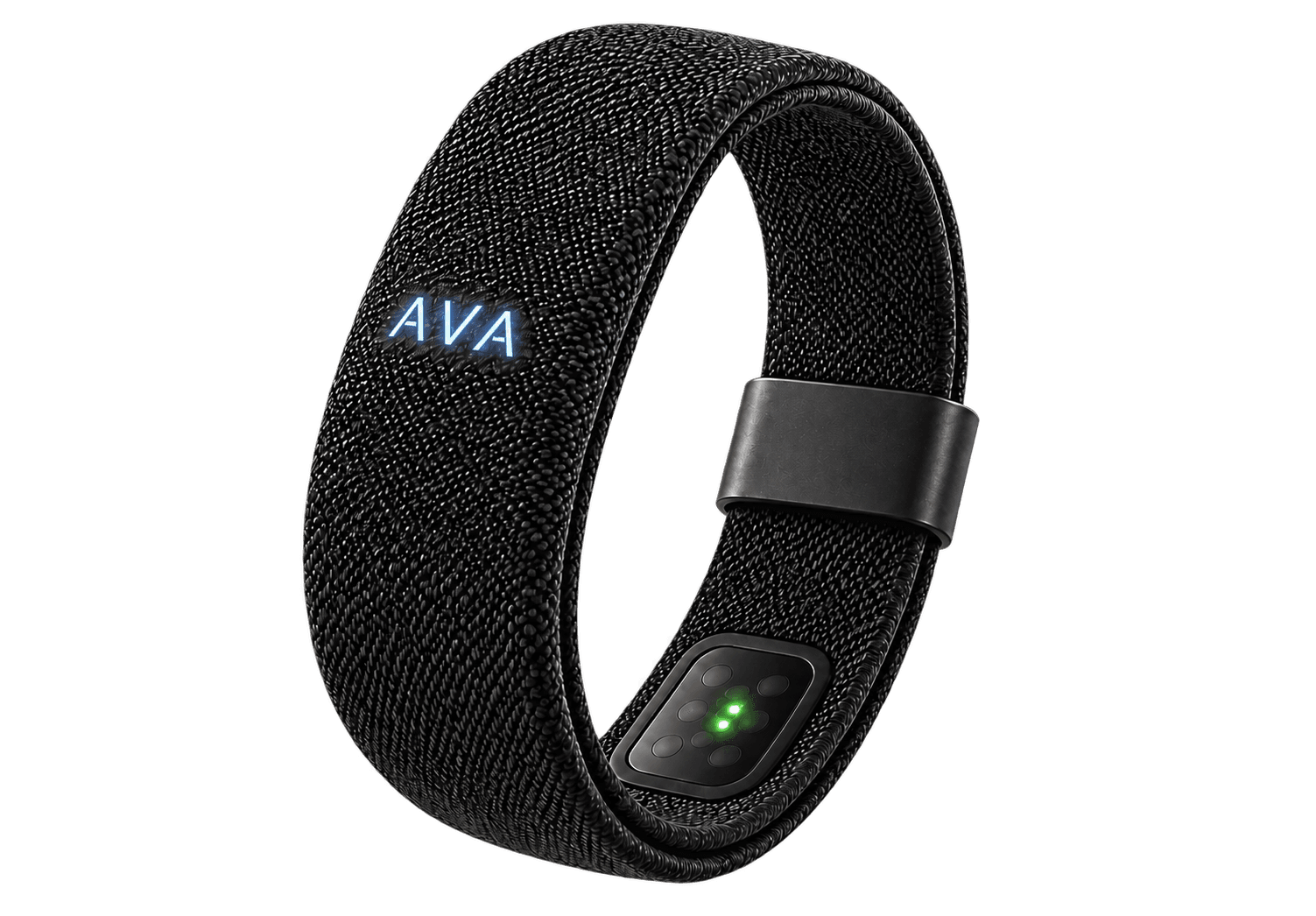
11 / Connectivity
Core resident interactions should not depend on carrying, charging, unlocking or understanding a phone.
12 / Site infrastructure
Deployments may combine cellular connectivity with local AVA infrastructure for band coordination, device management, event routing and appropriate fallback behaviour.
13 / Trust
Trust is an operating model: explicit permissions, bounded access, clear policy and an audit trail for meaningful actions.
Personal information is shared according to explicit permissions and deployment policy.
Staff access should reflect role and responsibility.
Being family does not mean unrestricted access to health, memories, conversation, location or activity.
Meaningful safety and care actions should leave an appropriate audit trail.
Microphone behaviour must be governed by consent, policy and deployment configuration.
Capture and retain only what is necessary for the service being provided.
14 / AI governance
AVA uses AI to understand context and communicate naturally. Permissions, safety boundaries and high-consequence actions are enforced separately from the language model. This is fundamental to AVA Care.
15 / Organisation controls
Target platform architecture includes safety policies, resident permissions, trusted contacts, quiet hours, staff roles, notification routing, voice behaviour, family access and retention policy.
16 / Integrations
AVA's integration layer is being designed around secure APIs and configurable connectors for care management, communications, scheduling, telephony, identity and building systems.
17 / Human time
AVA's goal is to handle appropriate routine interactions, reminders, routing and contextual information so staff can focus attention where human care matters most.
Routine reminders · schedule questions · family calls · routing requests · device issues · possible safety checks
AVA does not replaceHuman care · professional judgement · relationships · complex support · emergency response
18 / Deployment
A credible path to adoption—not a request to purchase an untested fleet.
Resident needs, staff workflows, existing technology, infrastructure, privacy and safety policy.
A defined resident cohort, staff group, site or unit and a tightly scoped set of use cases.
Engagement, response, alert burden, reliability, workflow impact and safety processes.
Expand deliberately across a unit, site, group or organisation when the evidence supports it.
19 / Early pilot programme
We are speaking with care providers, supported-living organisations and industry experts interested in helping shape AVA Care.